Hello, I’m Serhat Engul, a licensed tour guide and writer based in Istanbul.
For more than two decades, I have guided travelers through this city and its many layers of history. My fascination with the Middle Ages began long before guiding became my profession — a story I tell more fully on the About page.
But living and working in Istanbul gave that fascination a new direction.
Here, Byzantine history still occupies physical space.
The walls of Constantinople still cross the city. A Roman aqueduct still strides above a modern boulevard. Ancient cisterns survive beneath busy streets. Byzantine churches remain standing, many preserved through centuries of later use, including their conversion into mosques. Mosaics still hold the faces of emperors, empresses and saints. Relics and sacred objects survive in historic churches, including the Ecumenical Patriarchate.
For someone who loves history, Istanbul offers an extraordinary privilege:
the stories still have places to stand.
History Becomes Memorable When It Becomes Human
On my Byzantine tours, dates, monuments and architecture matter.
But they are only the beginning.
What people tend to remember is the moment a monument becomes part of a human story.
That same impulse lies behind Byzantine Stories.
The site tells narrative histories of travelers, emperors and empresses, saints, diplomats, soldiers, pilgrims, artists, relics, ceremonies, lost places and ordinary people caught inside extraordinary events.
The aim is not to invent a more dramatic Byzantium.
It is to discover how much drama is already there.
Start with Arculf
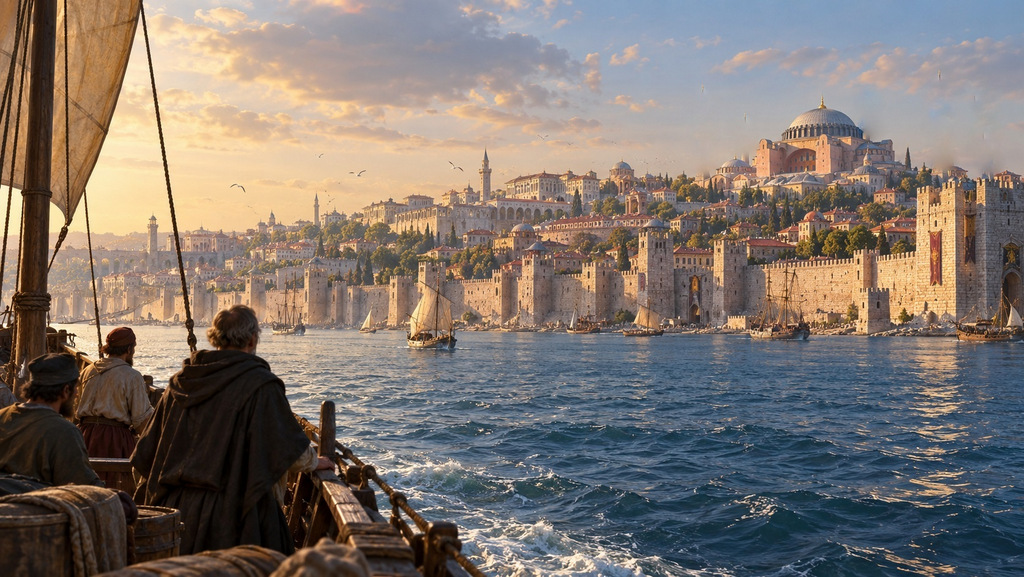
The first story in the new series follows Arculf, a western bishop who spent months in Constantinople in the seventh century.
He does not give us the city we expect.
He says surprisingly little about monuments such as Hagia Sophia or the imperial palace.
Instead, he remembers a relic of the True Cross, miraculous images, stories of St George and a strange foundation legend in which the builders’ tools disappear during the night and reappear across the water.
His Constantinople was a city of sacred objects, miracles and stories.
That raises one of the questions at the heart of this project:
What did Constantinople look like to the particular person who actually saw it?
Begin with Arculf
Follow a seventh-century traveler through Constantinople, its relics, legends and sacred stories.
Read Arculf in ConstantinopleResearched History, Written as Story
Every major story begins with historical research.
Whenever possible, primary sources come first: chronicles, travel accounts, letters, saints’ lives, diplomatic reports and other texts written closer to the world we are trying to recover.
Modern scholarship helps establish context, identify problems and test interpretations.
Then comes the storytelling.
The goal is to make the material vivid, readable and human without pretending that the sources tell us more than they actually do.
At the end of major stories, a Behind the Story section shows the ground beneath the narrative: the principal sources, editions, uncertainties and important scholarly questions.
The principle is simple:
We know where the ground is solid. We also know how to tell a story on it.
Explore More Byzantine Stories
Three Ways to Explore Istanbul
Byzantine Stories is part of a wider group of projects that grew from my work as a guide and writer.
IstanbulClues.com
Visit the city.
Practical guides to Istanbul’s monuments, museums, neighborhoods and cultural heritage from the perspective of a professional guide.
ByzantineIstanbul.com
Understand the Byzantine city.
Deeper historical context for Constantinople: its architecture, churches, palaces, emperors, topography and surviving heritage.
ByzantineStories.com
Enter the human story.
The people, objects and events preserved in texts, monuments and fragments — retold through source-based narrative history.
One helps you visit Istanbul.
One helps you understand its Byzantine past.
And this one tries to make you imagine it.
Walk Through the Real Byzantium
Many of the places behind these stories still survive in Istanbul.
Hagia Sophia.
The Theodosian Walls.
Ancient cisterns.
Byzantine churches.
Columns, mosaics and fragments of a city that once stood at the center of an empire.
I continue to explore this heritage with travelers through my Byzantine history tours in Istanbul.
Reading about Constantinople is one way to encounter it.
Standing where part of the story happened is another.
From Dreams to Sources
Byzantine Stories originally began as an experiment in historical dream fiction.
The first three stories followed Stavros, a fictional modern character who entered the Byzantine past through dreams.
Those stories remain on the site as The Stavros Cycle, the creative beginning of the project.
But Byzantine Stories has grown into something broader.
Instead of asking where a fictional character should travel next, the project now begins with another question:
What human story is already waiting inside the sources?
Artificial intelligence supports parts of the research, drafting, editing and visual process. Every story is checked against its sources, edited and approved by me before publication.
The subject remains Byzantium.
The Byzantine world already left us battles and pilgrimages, court ceremonies and diplomatic insults, relics and legends, ruined palaces and surviving mosaics, saints, emperors, travelers and ordinary people trying to make sense of their own age.
Much of it sounds invented.
It is not.
Sometimes all we need to do is look closely enough at what survived.
Welcome to Byzantine Stories.
Serhat Engul
Licensed Tour Guide & Writer
Istanbul