The City Chosen in the Night
Constantinople, late seventh century
This story is based primarily on Book III of Adomnán of Iona’s De Locis Sanctis, an account shaped from the testimony of a traveling bishop named Arculf and from other material available to its author.
Alexandria lay behind him.
Arculf had already spent a long time in the East. He had walked among the holy places of Palestine, traveled through Syria and Egypt, and crossed the Mediterranean from Alexandria to Crete.
From there he sailed north.
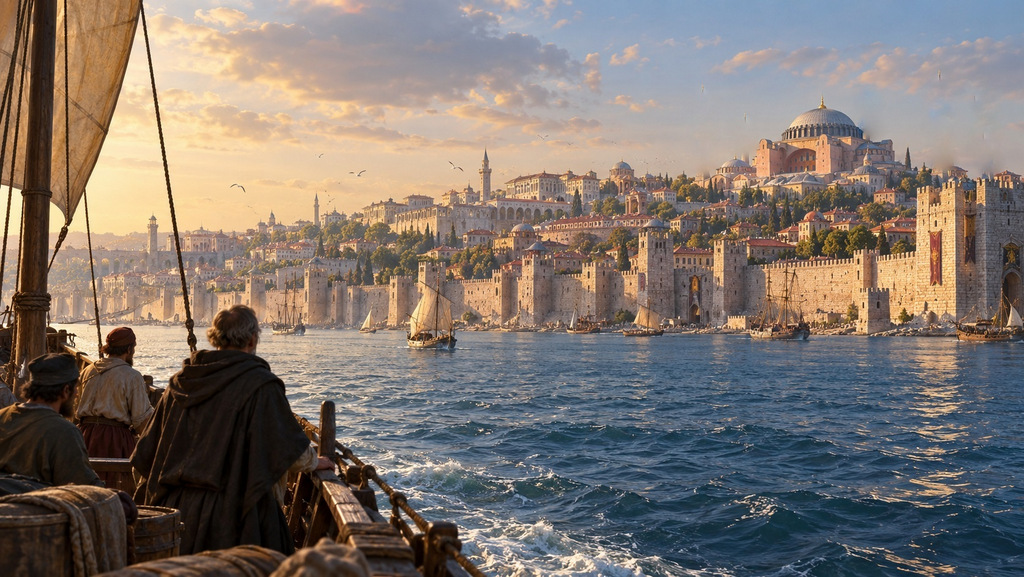
Then the city rose before him.
Walls followed the shoreline. Towers broke their long line at intervals. Behind them stood a mass of stone houses, some so large that they would later be compared with the great houses of Rome.
Constantinople.
Arculf had come from Gaul. Here the Roman Empire was not a memory.
An emperor still ruled.
Armies still marched in his service.
And years later, on the distant island of Iona, Constantinople would be described in the account of Arculf’s travels for what it still was:
the metropolis of the Roman Empire.
Arculf did not stay for a few days.
He was there at Easter.
Spring passed.
Then summer.
Then autumn.
When the days shortened and Christmas approached, the western bishop was still in the imperial capital.
Months in a city are long enough to learn more than its streets.
They are long enough to learn its stories.
One of those stories explained why Constantinople stood where it did.
The citizens told Arculf that Constantine had originally intended to build his new city on the Asian side of the water.
Workers had gathered in enormous numbers. The camp was ready. The tools of the different trades had been brought together.
Then night came.
The workers slept.
By morning, every tool was gone.
Constantine ordered both sides of the sea searched.
Eventually the missing equipment was found — not where it had been left, but across the water on the European shore, gathered together on the land between two seas.
Trumpets sounded through the camp.
Ships were prepared.
The workers crossed.
According to the story, Constantine understood that the tools had not been moved by human hands.
God had shown him where the city was meant to rise.
And so they began again.
More than three centuries after Constantine, this was the foundation story people in Constantinople were still telling.
By then the city had lived long enough to acquire a second history: not merely the history of how it had been built, but a story explaining why it could only have been built here.
Between Asia and Europe.
Between the seas.
Constantinople was no longer simply Constantine’s creation.
It had become the chosen city.
Yet the object that seems to have mattered most to Arculf was older than Constantinople itself.
A piece of wood.
Inside a celebrated round stone church whose precise identity is now uncertain, Christians venerated pieces believed to belong to the Cross of Christ.
They were kept behind several layers of enclosure.
Inside a wooden chest was another reliquary.
Inside that were three pieces of the Cross.
Most of the year they remained shut away.
For three successive days around Easter, they emerged.
On the day of the Lord’s Supper, the emperor entered the church with the soldiers.
The chest was opened and placed upon a golden altar.
The emperor came first.
The ruler of the Roman world bowed his head and kissed the wood.
Then the soldiers approached, one after another, according to their rank and age.
The following day belonged to the women: women of the imperial household, matrons, and the other women of the city.
On Holy Saturday, the bishop came forward.
The clergy followed him.
Arculf said he had seen the Cross himself.
He said he had kissed it.
Then the scene became stranger.
When the chest was opened, fragrance filled the church.
It was described as though the sweetness of every flower had somehow been gathered into one place.
From knots in the wood, a fragrant liquid like oil was said to emerge. Even a small drop placed upon the sick was believed to restore them to health.
For the people inside that church, holiness was not an abstract idea.
It had weight, scent and texture.
It could be seen.
Smelled.
Touched.
Kissed.
And at the beginning of the ceremony stood the emperor, bending before three pieces of wood.
Arculf also listened.
Some of the people he met in Constantinople told him stories about St George.
The first did not take place in the capital at all. It belonged to Diospolis in Palestine.
There, according to the story, an image of George had been made on a marble column. People said the saint had once been bound to that column and flogged during a persecution.
One day a mounted man entered the building.
He asked whose image he was looking at.
George, they told him.
The man became angry and drove his lance into the image.
The marble behaved as marble should not.
The spear sank into it as though the stone were soft snow.
The point became trapped.
At the same moment the horse collapsed dead beneath its rider. As the man fell, he threw out his hands against the column.
His fingers sank into the stone.
All ten.
He could not pull them free.
He repented, the story says, and called upon God and George.
His hands came free.
But the marks remained.
So did, people claimed, the blood of the horse upon the floor.
Then comes the detail that gives the tale its peculiar power.
Arculf said he had seen the column.
He said he placed his own hands against it and pushed his ten fingers into the marks left in the marble.
All the way to their roots.
A story told in Constantinople had become something he could touch.
Thirteen centuries later, whatever physical marks once existed and the miracle story that explained them can no longer be separated.
Arculf did not live in that distance.
For him, the marks and the story belonged to the same world.
The Constantinopolitans told him another story about George.
This time a man was about to leave Diospolis on a dangerous expedition.
Before going, he entered the place where George’s image stood and made a promise.
If he and his horse returned safely, he would give the horse to the saint.
It was not an insignificant gift.
In his vow, he called it the horse he loved above all.
He survived the expedition.
So did the horse.
The man returned to Diospolis, entered the building, and placed twenty gold coins before the image instead.
Then he went outside and mounted.
The horse refused to move.
He went back in and added ten more coins.
He tried again.
Nothing.
Another ten.
Still nothing.
Back and forth he went between the saint and the immovable horse until the offering had reached sixty gold pieces.
The horse remained exactly where it was.
At last the man returned to George’s image with a clearer understanding of the terms.
He left the sixty gold pieces.
And he gave the saint the horse he had originally promised.
Only then did the animal move.
The scriptural lesson was clear enough: something dedicated to God was not simply his to buy back.
The story itself leaves a slightly more memorable impression.
George was not open to renegotiation.
Another story Arculf heard in Constantinople concerned a small wooden image of the Virgin Mary.
The tale carries the anti-Jewish hostility of the Christian world in which it was told.
It describes a Jewish man tearing the image from the wall of a house, deliberately humiliating it and throwing it into filth.
Later, a Christian found the panel.
He washed it.
He carried it home.
He placed it somewhere worthy of honor.
Then oil began to flow from the wood.
Arculf claimed that he saw the image himself.
Within the world of the story, the image was not simply decoration.
It could be dishonored.
It could be rescued.
It could receive reverence.
And it could answer.
The great imperial struggles over sacred images still lay in the future.
But the power attached to images was already very real.
Arculf remained in Constantinople for months.
And still he left us almost nothing about many of the places we most want him to describe.
Hagia Sophia had already stood for well over a century.
Constantine’s great porphyry column still rose in his forum.
The Hippodrome was there.
So was the imperial palace.
Did Arculf enter Hagia Sophia?
Did he watch the crowds of the Hippodrome?
Did he pass beneath Constantine’s column?
Perhaps.
He never tells us.
A modern traveler is expected to describe a city.
But every traveler notices a different city.
A diplomat remembers protocol.
A merchant remembers harbors and markets.
A soldier remembers walls.
A pilgrim remembers holy things.
Arculf’s Constantinople was held together by another geography: relics, images, miracle stories, and places where stone itself seemed capable of preserving memory.
Hagia Sophia survives.
So does Constantine’s column, darkened and battered by the centuries.
Arculf may have passed them both.
He chose to leave us other things.
Christmas approached.
At last Arculf left Constantinople and took ship for Rome.
On his westward journey he also passed Sicily, where he described the smoking island of Vulcano rising from the sea nearby.
Then another writer takes up the story.
Decades later, Bede recorded that Arculf was returning home by sea when a violent storm drove his ship onto the western coast of Britain.
Eventually the traveler reached Iona.
There, at the edge of the Atlantic world, he met Adomnán.
The abbot listened.
He questioned Arculf about the places he had visited and first wrote what he heard on tablets. Later, he transferred the material to parchment.
That small act of writing is one reason any of this survives.
But between seventh-century Constantinople and us stand several acts of memory.
Someone saw.
Someone listened.
Someone remembered.
Someone wrote.
And more than thirteen centuries later, what remains is not a complete map of the city.
Perhaps that is why it still feels alive.
A chest opened once a year.
The smell of flowers inside a church.
Ten fingerprints in marble.
A horse that would not move.
An image believed to give forth oil.
A heap of tools found on the other side of the sea.
Fragments.
But sometimes fragments are enough.
Look at them long enough, and behind them the lost city begins to appear.
Behind the Story
Arculf and Adomnán
Arculf did not leave an independent travel narrative written in his own hand.
His journey survives principally through De Locis Sanctis (“On the Holy Places”), composed by Adomnán, abbot of Iona. In the prologue, Adomnán describes Arculf as a bishop from Gaul and says that he questioned him carefully, first recording the material on tablets and later transferring it to parchment.
The work is more than a transcript of a traveler’s memories. Adomnán was a learned author who also used written material and shaped the book according to his own interests. Modern scholarship has therefore debated how far individual passages reflect Arculf’s direct observations, stories he heard while traveling, or other sources available to Adomnán.
The story above keeps that distinction in mind without interrupting the narrative every time the source changes level.
When was Arculf in Constantinople?
The precise chronology of Arculf’s journey is reconstructed rather than explicitly dated in the text.
An older chronology placed the pilgrimage around 670, which is why that date appears in many earlier summaries.
Denis Meehan proposed a later reconstruction, dating Arculf’s Near Eastern travels approximately to 679–682. On that chronology, his long stay in Constantinople probably belongs around 680–681, although the exact year is not certain.
For that reason the story uses the broader and safer description “late seventh century.”
What the text itself states clearly is that Arculf remained in Constantinople from Easter until Christmas.
The city chosen by God
The story of Constantine’s missing tools comes from Book III of De Locis Sanctis and is presented as a tradition Arculf learned from inhabitants of Constantinople.
The text contains a geographical difficulty: the place on the Asian side where Constantine supposedly began building is unexpectedly called “Cilicia.”
Rather than silently replacing this with Chalcedon or another modern identification, the story simply says “the Asian side.”
The episode is not evidence for Constantine’s actual fourth-century planning decisions. Its historical value lies elsewhere: it shows how people in seventh-century Constantinople could tell the story of their own city’s foundation.
The True Cross
Arculf’s account describes a round stone church in Constantinople containing three pieces believed to belong to the True Cross. The precise identification of this church remains uncertain.
The relic was displayed on three successive days. First came the emperor and soldiers; on the next day came women of the imperial household, matrons and the other women of the city; on Holy Saturday came the bishop, followed by the clergy.
Arculf is explicitly said to have seen and kissed the Cross.
The fragrance and oil-like liquid are also part of the medieval account. They are presented in the story as beliefs and claims belonging to the devotional world Arculf encountered, not as independently verified physical phenomena.
St George and Diospolis
The two stories about St George were told to Arculf by informants in Constantinople, but their setting was Diospolis in Palestine.
The text says that Arculf himself saw the marble column associated with the first story and placed all ten of his fingers into the marks in the stone.
In the second tale, the man describes the horse in his vow as an animal he loved deeply. After unsuccessfully trying to substitute increasing amounts of gold, he ultimately leaves both sixty gold pieces and the horse.
The humor in the narrative is ours; the strange sequence of events is already in the source.
The image of the Virgin
The story of the Marian image is explicitly anti-Jewish in its medieval Christian framing.
It should not be read as straightforward evidence for the behavior of Jews in seventh-century Constantinople. It belongs to a wider tradition of Christian polemical stories in which attacks upon sacred objects are followed by miraculous responses.
It is nevertheless valuable evidence for the meanings Christians could attach to religious images.
Arculf is said to have seen the wooden image from which oil was believed to flow.
Rome, Sicily and the storm
At the end of the Constantinople section, De Locis Sanctis states that Arculf remained in the imperial capital from Easter until Christmas and then took ship for Rome.
The work also preserves his description of Vulcano, the volcanic island near Sicily.
The storm that later drove Arculf toward the western coast of Britain comes from Bede’s Historia Ecclesiastica Gentis Anglorum, Book V, chapter 15.
Bede does not say that the storm occurred immediately after Arculf left Rome. The story therefore keeps these pieces of the journey separate.
Principal edition
Adomnán of Iona, Adamnan’s De Locis Sanctis, ed. and trans. Denis Meehan, Scriptores Latini Hiberniae 3, 2nd ed. (Dublin: Dublin Institute for Advanced Studies, 1983).
The Latin text and Meehan’s English translation are available electronically through the CELT — Corpus of Electronic Texts project at University College Cork.
An older public-domain English translation is:
James Rose Macpherson, The Pilgrimage of Arculfus in the Holy Land : About the Year A.D. 670 (Palestine Pilgrims’ Text Society, 1889).
For Arculf’s storm-driven arrival in Britain:
Bede, Historia Ecclesiastica Gentis Anglorum, V.15.
Further reading
Thomas O’Loughlin, Adomnán and the Holy Places : The Perceptions of an Insular Monk on the Locations of the Biblical Drama (London and New York: T&T Clark, 2007).
David Woods, “Arculf’s Luggage: The Sources for Adomnán’s De Locis Sanctis,” Ériu 52 (2002), 25–52.
Ora Limor, “Pilgrims and Authors: Adomnán’s De Locis Sanctis and Hugeburc’s Hodoeporicon Sancti Willibaldi,” Revue Bénédictine 114.2 (2004).
Rodney Aist, “Adomnán, Arculf and the Source Material of De Locis Sanctis,” in Jonathan M. Wooding, Rodney Aist, Thomas Owen Clancy and Thomas O’Loughlin, eds., Adomnán of Iona: Theologian, Lawmaker, Peacemaker (Dublin: Four Courts Press, 2010), 162–180.
Want to explore more stories from the Byzantine world? Explore more Byzantine stories