My name is Serhat Engul. I am a licensed tour guide and writer based in Istanbul, and for more than two decades I have introduced travelers to the history of this city.
My fascination with the past began much earlier.
Growing up, I discovered the Middle Ages through films such as The Name of the Rose, Braveheart, Robin Hood and The Messenger: The Story of Joan of Arc.
They were not always accurate — Braveheart least of all — but they did their job.
They made me curious.
It took me years to notice something those films had in common. They all belonged to the medieval West.
None of them went to Constantinople.
Then I found myself living and working in a city where another Middle Ages had actually happened.
In Istanbul, that medieval world was Byzantium.
And much of it was still here.
Discovering the Other Middle Ages
The empire we now call Byzantine has always occupied a slightly unusual place in the popular imagination.
Ancient Rome is familiar. Medieval England and France come with recognizable kings, castles and crusades. The Renaissance has its artists and cities.
Constantinople is often less visible.
Yet for more than a thousand years it was the capital of the eastern Roman Empire and one of the great cities of the Mediterranean world.
Living in Istanbul changes the way you encounter that history.
The past is not confined to a page. Parts of the Roman and Byzantine city still survive in the streets, beneath them and inside buildings that have passed through many different lives.
That physical continuity became increasingly important to me as a guide.
You can read about Constantinople in the morning and later stand in front of something that belonged to its world.
Sometimes very little remains.
Sometimes an entire building does.
And sometimes the modern city has grown around a fragment without quite managing to erase it.
What Guiding Taught Me
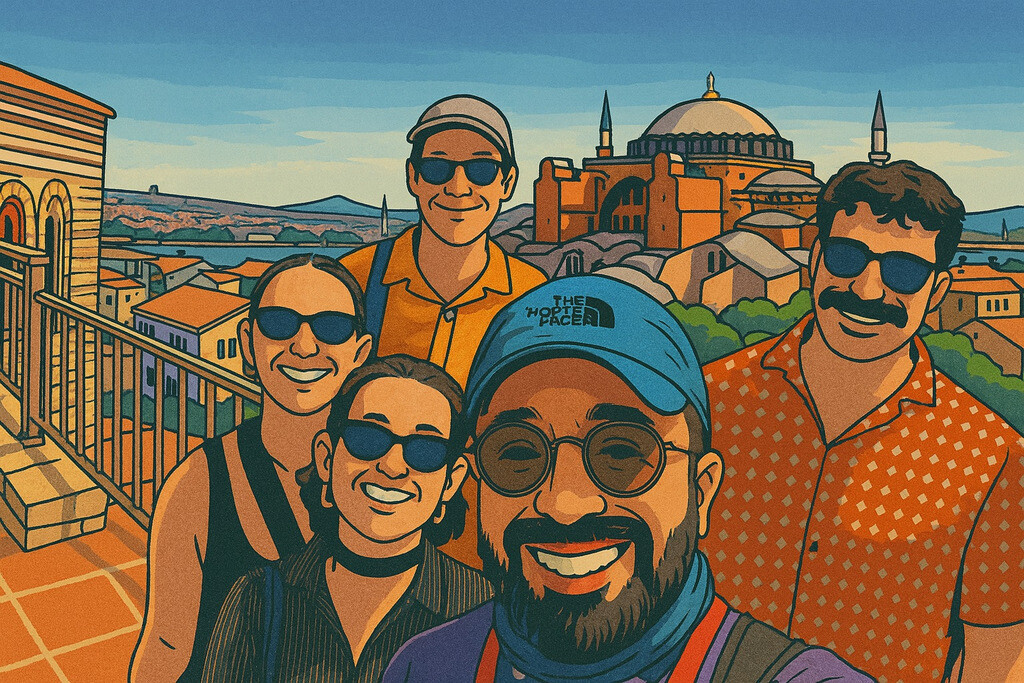
When I began guiding, history naturally came through monuments, dates, rulers and architecture.
All of those things matter.
But over time I realized that visitors rarely remember history because they have been given more information.
They remember it when information becomes human.
A mosaic changes when the face acquires a name.
A ruined palace becomes more interesting when you know who once waited inside it.
A relic that initially seems strange begins to make sense when you understand what medieval people believed it could do and why someone might travel hundreds of miles to approach it.
Those moments became the part of guiding I enjoyed most.
The moments when a visitor’s expression changed and I could see that Constantinople had briefly become visible behind Istanbul.
I did not think of myself as a storyteller then.
But that was already what I was trying to do.
Looking for the Person Inside the History
The more Byzantine history I read, the more my attention shifted away from history as a sequence of reigns.
I became interested in the person caught inside the event.
A traveler trying to describe something unfamiliar.
An ambassador offended by imperial protocol.
An empress appearing only briefly in the sources.
A pilgrim standing before a relic.
A strange detail preserved in a chronicle because someone, centuries ago, decided it was worth recording.
These fragments can open surprisingly large windows.
They also led me toward the question that now sits behind much of Byzantine Stories:
What was happening to this person, in this place, at this particular moment?
That question eventually became more useful to me than simply asking what happened during a certain reign.
Where Byzantine Stories Began
The project did not begin in its present form.
The first Byzantine Stories followed a fictional modern character named Stavros, a New Yorker of Greek background who entered Byzantine history through dreams.
Three stories came from that idea:
I still value them.
They gave me permission to write Byzantine history with more atmosphere, movement and imagination than I had allowed myself before.
But while working on Stavros, I began to notice a problem.
The passages I most wanted to write were always the Byzantine ones.
To continue Stavros properly, however, I would also have needed to build his modern life: his family, his relationships, his work, his psychology and the consequences of what happened to him in his dreams.
In other words, every new Byzantine story would require a second story running beside it.
Sooner or later, the history would have to serve the needs of a fictional modern character.
I wanted the opposite.
I wanted the historical material itself to decide where the project went next.
The turning point came with a simple change of question.
Instead of asking:
Where should I send Stavros?
I began asking:
Who was already there?
The People Were Already There
The answer was everywhere.
Real travelers had already arrived in Constantinople.
Diplomats had already entered the imperial palace.
Pilgrims had already searched for relics.
Emperors, empresses, patriarchs, monks, soldiers and foreigners had already left traces of themselves in chronicles, letters, travel accounts, saints’ lives and other surviving texts.
There was no need to invent a witness every time.
The witnesses already existed.
And quite often, what they recorded was stranger than anything I would have invented for them.
This changed the direction of Byzantine Stories.
The original dream stories remain part of the site as The Stavros Cycle. They are the creative beginning of the project, not something I want to erase or pretend never happened.
But they are no longer its main model.
The project found a wider form.
Where the Sources Become Stories
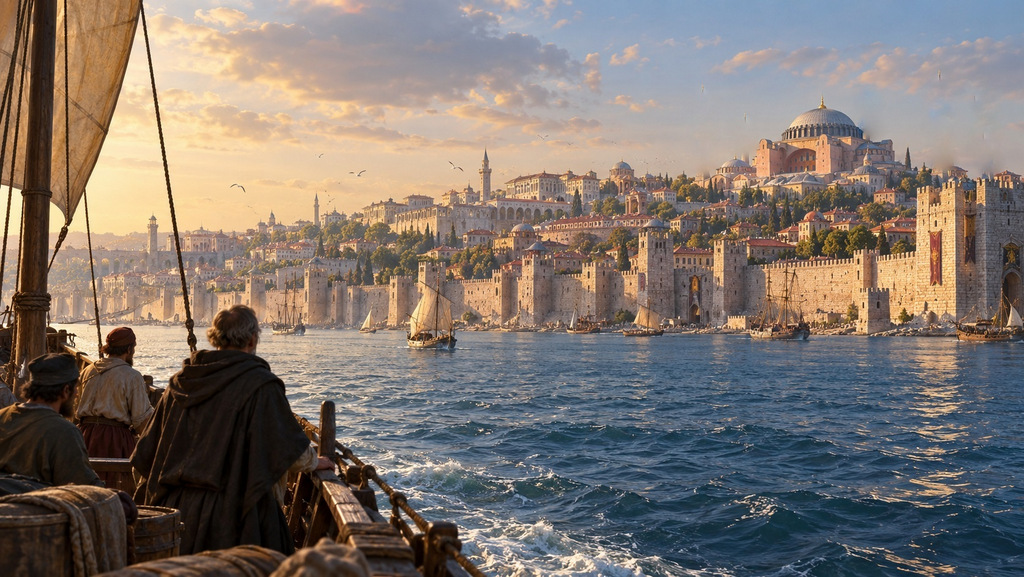
Today, Byzantine Stories is built around source-based narrative history.
A story may begin with a person, an object, a ceremony, a journey, a lost building or just a few unusual lines in a medieval text.
Then I want to know what the evidence can actually carry.
What does the earliest source say?
How close was its author to the event?
Is this eyewitness testimony, hearsay, hagiography, propaganda, tradition or later interpretation?
What has modern scholarship added?
Where does certainty end?
These questions establish the ground.
Then another kind of work begins.
The material has to become a story.
That means choosing scenes, finding rhythm, deciding what the reader needs to know and resisting the temptation to bury a living narrative beneath everything discovered during research.
I do not want academic papers disguised as stories.
But I do not want fiction disguised as history either.
The challenge — and the pleasure — is to find the space where historical discipline and narrative storytelling can work together.
Behind the Story
That is also why major pieces on the site include a Behind the Story section.
The main narrative should be allowed to move.
A traveler arriving in Constantinople should not have to stop every few paragraphs while the narrator explains manuscript history.
But the reader should still be able to see what the story rests on.
Behind the Story is where the main sources, editions, uncertainties and important scholarly problems become visible.
Sometimes the answer is clear.
Sometimes it is not.
A lost church may no longer be identifiable. A medieval author may repeat a miracle that cannot be independently verified. Two sources may preserve different versions of the same event.
I do not see those uncertainties as things to hide.
Used carefully, they can bring us closer to the way the past actually survives: incomplete, layered and occasionally contradictory.
Why Istanbul Still Matters
Byzantine Stories is not limited to Constantinople.
The Byzantine world extended far beyond it, and the stories on this site can travel wherever the sources lead — into the Balkans, Anatolia, Italy, the eastern Mediterranean and beyond.
But Istanbul will always give this project a particular perspective.
It is where my professional life and my historical interests meet.
I can spend hours reading about a place and then go outside and walk through the geography that shaped it.
Even when a monument has vanished, knowing the modern city changes the way I imagine the old one.
Years of guiding have also taught me which details make people lean closer, which stories need more context and which fragments suddenly make a remote historical world feel understandable.
That experience inevitably enters the writing.
A Family of Projects
Byzantine Stories belongs to a wider group of projects that grew from my work in Istanbul.
IstanbulClues.com is closest to my work as a professional guide, helping travelers understand and visit the city they encounter today.
ByzantineIstanbul.com concentrates more deeply on Constantinople itself: its monuments, history, topography and surviving Byzantine heritage.
ByzantineStories.com follows the human stories hidden inside that history.
They are connected, but they serve different purposes.
Some subjects also develop into separate Turkish narratives for İstanbulHikayeleri.com. The Turkish and English stories may grow from the same research, but they are written as natural texts in their own languages rather than translations of one another.
AI and the Workshop
Artificial intelligence is part of the way Byzantine Stories is made, and I prefer to be straightforward about that.
Drafts are often developed with AI. I also use it for research assistance, source comparison, organization, structural editing, language work and visual experimentation.
It has become a powerful tool for turning large amounts of historical material into a manageable creative process.
But the historical standard does not change because the tools have changed.
Sources still have to be checked.
Claims still have to survive scrutiny.
A beautiful sentence cannot rescue a bad historical assertion.
Every story is reviewed against its evidence, edited and approved by me before publication.
AI is part of the workshop.
The subject is Byzantium.
An Old Ambition in a New Form
For most of my professional life, I thought of myself primarily as a tour guide.
Over time, I understood that the part of the work I loved most was telling stories.
Guiding gave me the city.
Reading gave me the past.
Research gave me the evidence.
And the tools available today have made it possible to bring those things together in ways I could not have managed before.
Byzantine Stories is where that ambition has found its form.
The more deeply I enter the sources, the less I feel the need to make Byzantium more dramatic than it already was.
Its surviving texts contain journeys, rivalries, rituals, fears, misunderstandings, violence, faith, ambition and ordinary human behavior.
Sometimes the material is spectacular.
Sometimes it is only a fragment.
Both can become stories.
The task is to recognize what the evidence gives us, resist the urge to pretend we know what it does not, and still write well enough that the people behind those fragments begin to feel present again.
That is what I hope to do here.
To make Byzantium visible again — not by replacing the past with imagination, but by using imagination carefully enough to enter what the past has left behind.
Welcome to Byzantine Stories.
Serhat Engul
Licensed Tour Guide & Writer
Istanbul